Google 3D Animals and AR Objects: Complete Search List
Google Search can place selected animals, dinosaurs, human anatomy models, cultural objects and other educational 3D models on your screen—and, on compatible phones, inside your room with augmented reality. This guide explains exactly how to find them, which devices work, what to search for and how to fix a missing View in 3D or View in your space button.

How to use Google 3D Animals
You do not need a separate animal app. The experience is built into supported Google Search results on mobile devices. Google’s current instructions are simple: search for an animal, object or place, open its 3D result, and then choose the AR option if your phone supports it. The exact labels can vary slightly by phone and language.
- Open the Google app or a mobile browser and go to google.com.
- Search for a specific supported term, such as tiger, giant panda or great white shark.
- Scroll through the knowledge panel until you see a card that says Meet a life-sized… up close or a button labeled View in 3D.
- Tap View in 3D to open the model against a plain background.
- Rotate, zoom and inspect the object. If AR is supported, tap View in your space or AR.
- Allow camera and motion access when prompted, then slowly move your phone so it can understand the floor and nearby surfaces.
Using Object View
Object View is the easiest mode because it does not need to map your room. It displays the animated model on a neutral background. Drag one finger to rotate it, drag or swipe to change the angle, and pinch with two fingers to zoom. This is useful when you want to study details without granting camera access or when your phone can show 3D content but does not support the full AR experience.

The share control creates a link to the relevant Google result, so another person can open the model on a compatible phone. Sharing availability depends on the model and browser. For a clean screenshot, rotate the object first, wait for its animation to settle, and capture the screen with interface controls hidden if your device offers that option.
How to put a Google 3D animal in your room
AR mode combines the digital model with the live camera view. For the best result, use a well-lit room with a clear, textured floor. A blank white surface, darkness or fast camera movement makes tracking harder. Point the phone downward and move it slowly from side to side until the placement indicator appears.

Grant the required permissions
- After opening the model, tap View in your space or AR.
- Approve camera access. Android may also ask for access required by Google Play Services for AR.
- Follow the on-screen prompt to move the phone. Keep the lens aimed at the floor and avoid covering the camera.
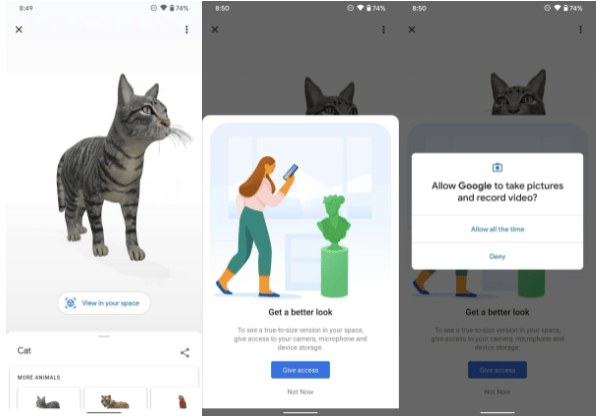
Place and move the model
When a surface is detected, the animal or object appears in the camera view. Drag it with one finger to reposition it. If it looks as though it is floating or sinking through the floor, scan the surface again and place the model on a clearly visible area. Some models initially open at an estimated life-size scale, which can make large animals difficult to fit in a small room.

Resize, rotate, photograph and record
Pinch inward or outward with two fingers to change scale. Rotate with two fingers when the interface supports it, or drag around the model to change your viewing angle. You can use the on-screen shutter control for a photo; holding it may record video on supported versions. The model keeps animating while you move, which can make short clips more convincing.

What is object blending?
Object blending, sometimes described as occlusion, helps a virtual subject appear behind real objects instead of being drawn over everything in the camera feed. When supported, the phone estimates depth and surfaces so part of an animal may disappear naturally behind furniture. The result depends heavily on lighting, camera quality and the shapes in the room; it is an illusion, not a precise room scan.

If your version shows a half-shaded circle or blending control, tap it to compare the effect on and off. Stand closer to the virtual subject and allow a few seconds for the scene to update. This option is not displayed on every phone or every model.
Which phones support Google 3D Animals?

Android
Google says 3D results require a phone running Android 7 or later. Placing the object in your space additionally requires an ARCore-supported device. The safest check is Google’s current ARCore supported-device list, because compatibility depends on the exact model.
iPhone and iPad
Google’s help page lists iPhone 6s or later, iOS 11 or later, and Safari or the Google app for viewing and interacting with 3D results. A recent iOS version and updated browser normally provide the best result.
| Feature | Android requirement | Apple requirement |
|---|---|---|
| Open a 3D model | Android 7 or newer | iPhone 6s or newer with iOS 11+ |
| Place model in the room | ARCore-supported phone | Compatible iPhone/iPad using Safari or Google app |
| Camera access | Required for AR mode | Required for AR mode |
| Internet connection | Required to load the Search result and model | |
Do not assume that a famous phone family is supported just because an older model worked. Hardware variants, certification and software updates matter. If View in 3D works but View in your space does not, the usual explanation is that the phone can render the model but does not meet the AR requirement.
Google 3D Animals list
The following groups combine the examples currently named in Google’s official Search help with additional models that have appeared in Google Search. Begin with the officially documented examples, marked below as the most reliable searches. Google can change availability without announcing a fixed catalog, so treat this as a practical search checklist rather than a guarantee.
Land animals
- Tiger, giant panda, leopard and cheetah
- Goat, pony, Shetland pony and Arabian horse
- Brown bear, timber wolf, raccoon, hedgehog and deer
- Python and other supported snakes
- Lion, zebra, giraffe, elephant, hippopotamus and rhinoceros may appear depending on availability
Pets and domestic animals
- Pomeranian, golden retriever, Labrador retriever and Rottweiler
- French bulldog, pug and cat
- Other breeds historically surfaced in Search include beagle, border collie, German shepherd, pit bull, Shiba Inu, Siberian husky and Welsh corgi
Water, wetland and marine animals
- Mallard duck and alligator
- Great white shark, octopus, angler fish and sea turtle
- Availability has also been reported for dolphins, jellyfish and selected fish species
Birds
- Macaw, emperor penguin and eagle are examples named by Google
- Some regions or searches may also surface other birds, but a generic search such as “bird” is less reliable than a specific species name
Dinosaurs and other Google AR objects
Animals receive most of the attention, but Google Search has also offered educational models from science, history and culture. Some collections are available only in English. Search the exact term rather than a broad subject such as “anatomy,” then look for the 3D card in the result.
Dinosaurs
- Tyrannosaurus rex
- Velociraptor
- Triceratops
- Spinosaurus
- Stegosaurus
- Brachiosaurus
- Ankylosaurus
- Dilophosaurus
- Pteranodon
- Parasaurolophus
Dinosaur scale is especially dramatic in AR. If a full-size model will not fit, pinch to reduce it or try outside in an open area. The models are visualizations, so use museum or scientific sources when exact anatomical interpretation matters.
Human anatomy and biology
Google’s official examples include the digestive, respiratory, endocrine, nervous, lymphatic, skeletal, muscular, circulatory, urinary and reproductive systems. Cellular structures include mitochondria, bacteria, plant and animal cells, Golgi apparatus, ribosomes, cell membranes and related components. These models are helpful for orientation and classroom demonstrations, but they are not medical advice or a replacement for an anatomy reference.
Chemistry and physics
Search may display 3D educational results for terms such as functional group, organic chemistry, methyl acetate, propanol, salicylic acid, hydrocarbon, alkane, ionic bond, covalent bond, metallic bond, ethene, orbital hybridization and quantum mechanical model. Google also names solenoid as a physics example. English queries are the best starting point because Google says several scientific groups are English-only.
Space and cultural objects
Availability has included planets, space hardware and cultural artifacts. Google’s official help currently gives Apollo 11 Command Module and Neil Armstrong as cultural-object examples. For landmarks and heritage sites, examples include Chichén Itzá, Brandenburg Gate, the Jefferson Memorial, Gateway of India, Chauvet Cave and Ahu Nau Nau.
Do Google 3D Animals have sound?
Many animal models include synchronized sound, such as a tiger roar, dog bark or duck call. Sound behavior varies by model, device and browser. Check that media volume is raised and silent mode is off. If animation works but audio does not, tap the model once, reload it in the Google app, or test another animal before changing system settings.
Why “View in 3D” or “View in your space” is missing
| Problem | Likely cause | What to try |
|---|---|---|
| No View in 3D card | Unsupported query, language, region or desktop search | Use a mobile phone, search an exact English term such as “tiger,” and try the Google app or google.com. |
| 3D works but AR is missing | The device can render 3D but is not ARCore-compatible, or AR services are unavailable | Check the official ARCore device list and update Google Play Services for AR. |
| Camera opens but model never appears | Poor surface detection | Use brighter light, point at a textured floor and move slowly in a short side-to-side arc. |
| Permission error | Camera access was denied | Open phone settings, allow camera access for the Google app or browser, then reload the result. |
| Model jumps or floats | Tracking was lost | Re-scan the floor, avoid reflective surfaces and keep the phone steady. |
| Page freezes or stays blank | Low memory, stale browser data or a network problem | Close other tabs, update the app, switch networks and restart the phone. |
Android checklist
- Confirm the phone runs Android 7 or later.
- Look up the exact model on Google’s official ARCore list.
- Update the Google app, Chrome, Google Play Services and Google Play Services for AR.
- Allow camera permission for the app you are using.
- Search in English and test a well-known model such as tiger.
- Restart the phone if the AR service was just installed or updated.
iPhone and iPad checklist
- Use an iPhone 6s or newer with iOS 11 or later, as specified by Google Search Help for iPhone and iPad.
- Open Safari or the Google app rather than an embedded browser inside another app.
- Allow camera access and reload the result.
- Update iOS and the Google app if controls appear but the model will not load.
If you use several Google products at home, our guide to Google Nest parental controls explains how to manage filters and supervised access across the same household ecosystem.
Frequently asked questions
Can I use Google 3D Animals on a computer?
The complete room-scale experience is designed for compatible phones and tablets. A desktop search may show information about the animal without the same mobile 3D and AR controls. Open the query directly on a supported mobile device.
Is Google 3D Animals free?
Yes. It is part of Google Search and does not require a paid subscription. Normal mobile-data charges can apply while the model downloads.
Do I need the Google app?
Not always. Google says Android users can use google.com or the Google app, while iPhone users can use Safari or the Google app. If one route fails, test the other.
Why can I see the model but not place it in my room?
Basic model rendering has lower requirements than AR placement. On Android, the phone must support ARCore for the in-room experience. Permissions or an outdated AR service can also hide or break the option.
Can I see Google 3D Animals without camera permission?
You can usually use Object View without the camera. Camera access is required only when you want to place the model in your surroundings.
Are all models life-size?
Many animal experiences begin at an approximate real-world scale, but presentation can vary and the model can usually be resized. Do not treat the visualization as a measurement tool.
Why is an animal from an older list no longer available?
Search features change, and availability can differ by language, region, account, device and query wording. Google’s own help page gives examples rather than promising a fixed universal catalog.
View in 3D
Use AR
The reliable way to make it work
Start with a supported mobile phone and an exact English search term. Open the 3D model first, then enable AR and scan a well-lit floor slowly. If “View in your space” is missing, check device compatibility before repeatedly changing permissions.
Bottom line
Google 3D Animals remains one of the simplest ways to demonstrate augmented reality without installing a dedicated content app. The key is to separate two requirements: many phones can display an interactive model, while placing it in the room requires compatible AR hardware and services. Use Google’s official help page and ARCore device list as the authority, search exact terms, and remember that the catalog is not identical for every user.
Last reviewed for accuracy: September 2026. Feature and model availability may change.


